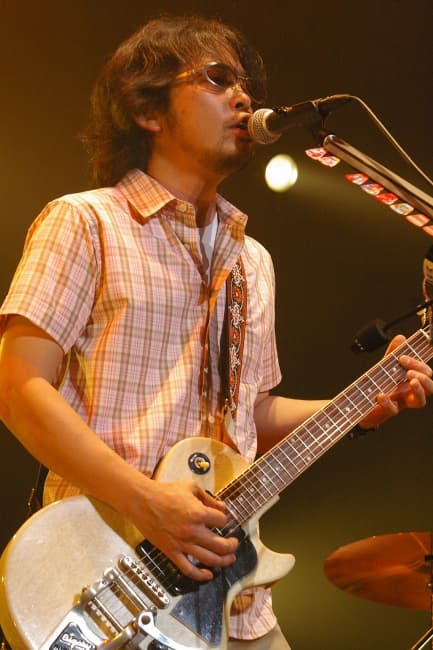
奥田民生
Laid-back Japanese rock with a vintage soul. Warm guitars and unhurried vocals that feel like a long drive through the countryside on a clear afternoon.
Laid-back Japanese rock with a vintage soul. Warm guitars and unhurried vocals that feel like a long drive through the countryside on a clear afternoon.
Tamio Okuda is the ultimate architect of 'natural' Japanese rock. His music feels lived-in, like a favorite denim jacket that has only gotten better with age. There is a distinct lack of pretension here; instead, you get masterfully crafted melodies that lean into the warmth of 70s rock and the grit of 90s alternative. It is music that breathes, characterized by a loose, swinging rhythm section and guitars that sound like they were recorded in a room full of vintage tube amps.
What truly sets him apart is his 'yurui' (relaxed) aesthetic. While his peers might chase trends or high-octane energy, Okuda is content to let a song simmer. His baritone delivery is conversational and effortless, often masking the sophisticated harmonic structures underneath. He possesses a rare ability to make complex power-pop arrangements feel as simple and essential as a folk song, often injecting a wry sense of humor or a touch of blue-collar melancholy into his lyrics.
For those new to his world, '29' or the compilation 'CAR SONGS OF THE YEARS' are the perfect entry points. They showcase his knack for writing anthems that don't need to shout to be heard. It is the sound of a musician who has nothing left to prove, making music for the sheer joy of the craft and the feeling of a well-traveled road.
Tamio Okuda (奥田 民生, Okuda Tamio; born 12 May 1965) is a Japanese singer, songwriter, and producer. He started his career in 1986 as a member of the band Unicorn. After Unicorn broke up, Okuda moved on to a solo career in 1994 with the single "Ai no Tame ni". He has written and composed many songs for various artists, particularly Puffy. He is signed to Sony Music Japan. He was ranked number 25 in a list of Japan's top 100 musicians, provided by HMV Japan in 2003. His band Unicorn was also ranked at number 61. Unicorn reunited in 2009. He appeared in the 2011 Batsu game on Gaki no Tsukai. He performed his song "Ai no Tame ni" with alternate lyrics to recap all that went on in the New Years' special. The Japanese dub of Cars 3 uses "Engine" as its ending theme. On July 11, 2018, Okuda, Kazuyoshi Saito, Yohito Teraoka (Jun Sky Walkers), Takashi Hamazaki (Flying Kids), Yo-King (Magokoro Brothers) and Tortoise Matsumoto announced the formation of a supergroup called the Curling Sitones (カーリングシトーンズ, Kāringu Shitōnzu). Each member is a multi-instrumentalist with all of them at-least being able to provide vocals and guitar and, like the Traveling Wilburys, each uses a pseudonym featuring "Sitone". They formed for a concert on September 23, 2018 at Zepp Tokyo celebrating Teraoka's 25th anniversary as a musician. In 2025, Okuda formed the unit Ooochie Koochie with Kōji Kikkawa.
Shares analog warmth, hand played, studio polished (production style); alternative rock, pop rock, classic rock (subgenres)

Shares analog warmth, hand played, studio polished (production style); alternative rock, classic rock, pop rock (subgenres)
Shares alternative rock, pop rock, classic rock (subgenres); analog warmth, studio polished, live recording (production style)

Shares pop rock, alternative rock, classic rock (subgenres); analog warmth, hand played, studio polished (production style)

Shares analog warmth, hand played, studio polished (production style); alternative rock, pop rock, classic rock (subgenres)

Shares analog warmth, hand played, studio polished (production style); playful, nostalgic, wistful (moods)
Shares analog warmth, hand played, studio polished (production style); nostalgic, playful, wistful (moods)

Shares pop rock, alternative rock, classic rock (subgenres); analog warmth, hand played, studio polished (production style)

Shares alternative rock, blues rock, classic rock (subgenres); analog warmth, hand played, studio polished (production style)
Shares analog warmth, hand played, studio polished (production style); alternative rock, pop rock, classic rock (subgenres)
Cassette uses generative AI to enrich its catalog. How we use AI →


