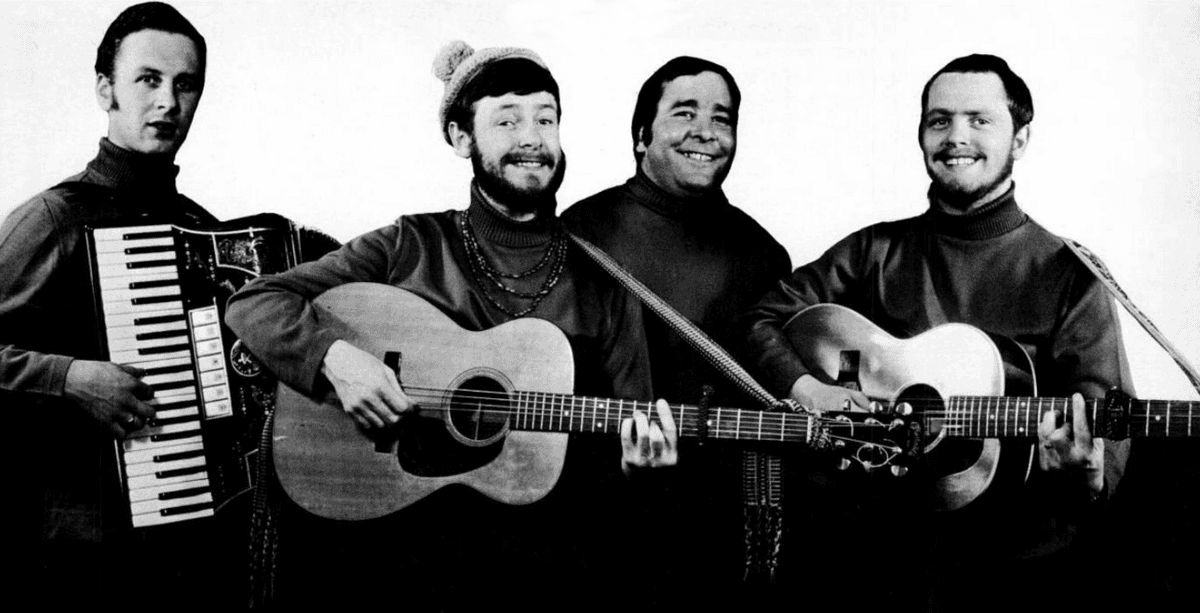
The Irish Rovers
Rousing pub anthems and whimsical story-songs led by bright accordion and group harmonies. The sound of a crowded tavern where everyone is a friend you haven't met yet.
Rousing pub anthems and whimsical story-songs led by bright accordion and group harmonies. The sound of a crowded tavern where everyone is a friend you haven't met yet.
The Irish Rovers represent the quintessential sound of the Irish diaspora, blending traditional Celtic instrumentation with a polished, North American folk-pop sensibility. Their music is defined by a relentless sense of hospitality; it is boisterous, welcoming, and fundamentally designed for communal participation. With a foundation of bright accordion, driving acoustic guitar, and nimble banjo, they create a sonic space that feels like a permanent celebration.
What sets them apart is their mastery of the narrative hook. While many folk groups lean into the somber or the political, the Rovers lean into the whimsical and the theatrical. They possess a rare ability to treat mythical creatures and hungover mornings with the same level of earnest, melodic charm. Their vocal arrangements are particularly distinctive, featuring tight, masculine harmonies that bridge the gap between traditional sea shanties and 1960s pop vocal groups.
Start with their classic hits like 'The Unicorn' or 'Drunken Sailor' to understand their cultural footprint. These tracks showcase their ability to turn simple folk melodies into international earworms. For a deeper dive into their instrumental prowess and more traditional roots, 'Gracehill Fair' offers a more mature but no less energetic look at their enduring legacy as Ireland's greatest musical ambassadors.
The Irish Rovers is a group of Irish musicians that was formed in Toronto, Ontario, Canada in 1963 and named after the traditional song "The Irish Rover". They are notable for their international television series, for contributing to the popularization of Irish music in North America, and for the songs "The Unicorn", "Drunken Sailor", "Wasn't That a Party", "The Orange and the Green", "Whiskey on a Sunday", "Lily the Pink", "Finnegan's Wake", and "The Black Velvet Band". The primary voices heard in the group's early songs were Will Millar (tenor), Jimmy Ferguson (baritone), George Millar, and Joe Millar, and in the last twenty years, also John Reynolds and Ian Millar. Wilcil McDowell's accordion was a signature sound of the band for more than fifty five years, until his retirement in 2020. Founding member George Millar and his cousin Ian are both from Ballymena, Davey Walker from Armagh, Sean O'Driscoll from Cork, Gerry O'Connor from Dundalk, percussionist Fred Graham from Belfast. Flute and whistle player Geoffrey Kelly was born in Dumfries, Scotland. In the 1980s, the group briefly renamed itself The Rovers. During this period, their song "Wasn't That a Party" led to crossover success in the country rock genre. The Irish Rovers have represented Canada at five World Expos, and in 2018 were honoured as one of Ireland's greatest exports at Dublin, Ireland's EPIC The Irish Emigration Museum. In 2023, they celebrated their 60th Anniversary, and their song, "Hey Boys Sing Us A Song" was nominated for Single of the Year in the Canadian Folk Music Awards.
Shares accordion, ocean, americana, traditional pop (instrumentation)
Shares acoustic folk, mandolin, banjo, americana (signature)
Shares acoustic folk, mandolin, accordion, ocean (signature)
Shares banjo, americana, traditional pop, acoustic folk (instrumentation)
Shares ocean, americana, traditional pop, acoustic folk (atmosphere)
Shares accordion, flute, americana, traditional pop (instrumentation)
Cassette uses generative AI to enrich its catalog. How we use AI →