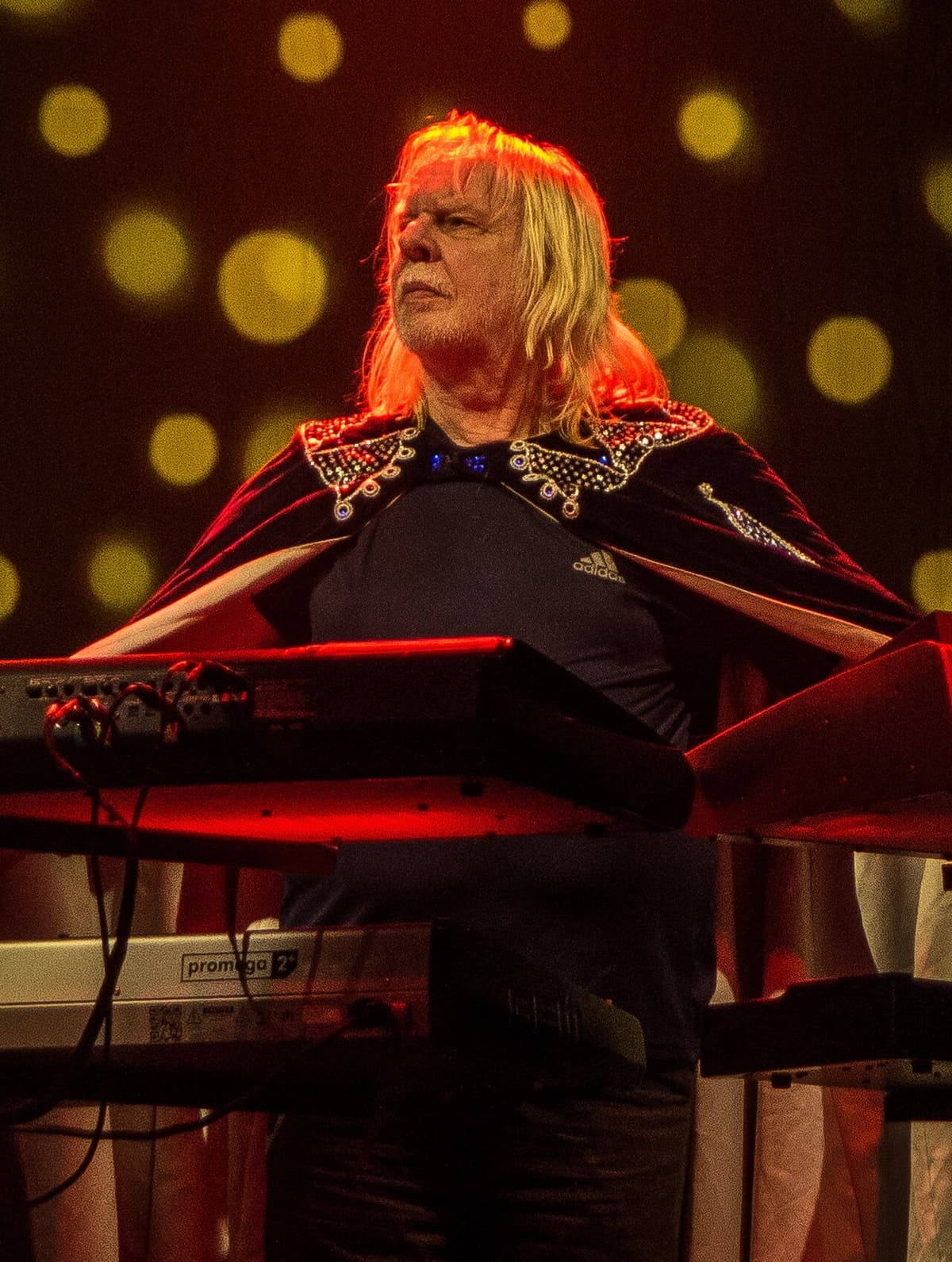
Rick Wakeman
Grand, virtuosic keyboard odysseys that merge classical majesty with rock energy. Shimmering Moogs and thundering organs for moments of epic discovery.
Grand, virtuosic keyboard odysseys that merge classical majesty with rock energy. Shimmering Moogs and thundering organs for moments of epic discovery.
Rick Wakeman is a foundational figure in progressive rock, primarily recognized for his virtuosic keyboard work with Yes and a prolific solo career defined by ambitious concept albums. Classically trained at the Royal College of Music, Wakeman brought a level of formal technical proficiency to rock that was virtually unprecedented in the early 1970s.
His sound identity is built on the simultaneous use of multiple keyboard stations, allowing him to switch rapidly between the Hammond organ's grit, the Moog's fluid leads, and the Mellotron's symphonic textures. Beyond his solo work, his session career is legendary, providing the iconic piano foundations for David Bowie's 'Life on Mars?' and Cat Stevens' 'Morning Has Broken'. His career arc moved from these high-profile sessions to the peak of 1970s prog-rock excess, later evolving into successful ventures in New Age, Christian music, and television. Critically, he is viewed as the ultimate keyboard showman, often credited with legitimizing the synthesizer as a primary lead instrument in a rock context. His influence is visible in nearly every subsequent prog-metal and symphonic rock act, from Marillion to Dream Theater.
Shares progressive rock, art rock, symphonic metal (subgenres); triumphant, mysterious, contemplative (moods)
Shares progressive rock, art rock, modern classical (subgenres); triumphant, contemplative, playful (moods)
Shares progressive rock, art rock, modern classical (subgenres); triumphant, mysterious, contemplative (moods)
Shares progressive rock, art rock, symphonic metal (subgenres); triumphant, mysterious, contemplative (moods)
Shares progressive rock, art rock, symphonic metal (subgenres); maximalist, orchestral_arrangement, studio_polished (production style)
Shares progressive rock, art rock, symphonic metal (subgenres); maximalist, orchestral_arrangement, studio_polished (production style)
Shares progressive rock, art rock, modern classical (subgenres); analog_warmth, maximalist, studio_polished (production style)
Shares progressive rock, art rock, symphonic metal (subgenres); triumphant, mysterious, contemplative (moods)
Shares progressive rock, art rock, symphonic metal (subgenres); maximalist, orchestral_arrangement, analog_warmth (production style)
Shares progressive rock, art rock, symphonic metal (subgenres); layered_dense, analog_warmth, orchestral_arrangement (production style)
Shares art rock, symphonic metal, maximalist, choir/choral (signature)
Shares symphonic metal, keys/synth, maximalist, mountain (subgenre)
Cassette uses generative AI to enrich its catalog. How we use AI →


