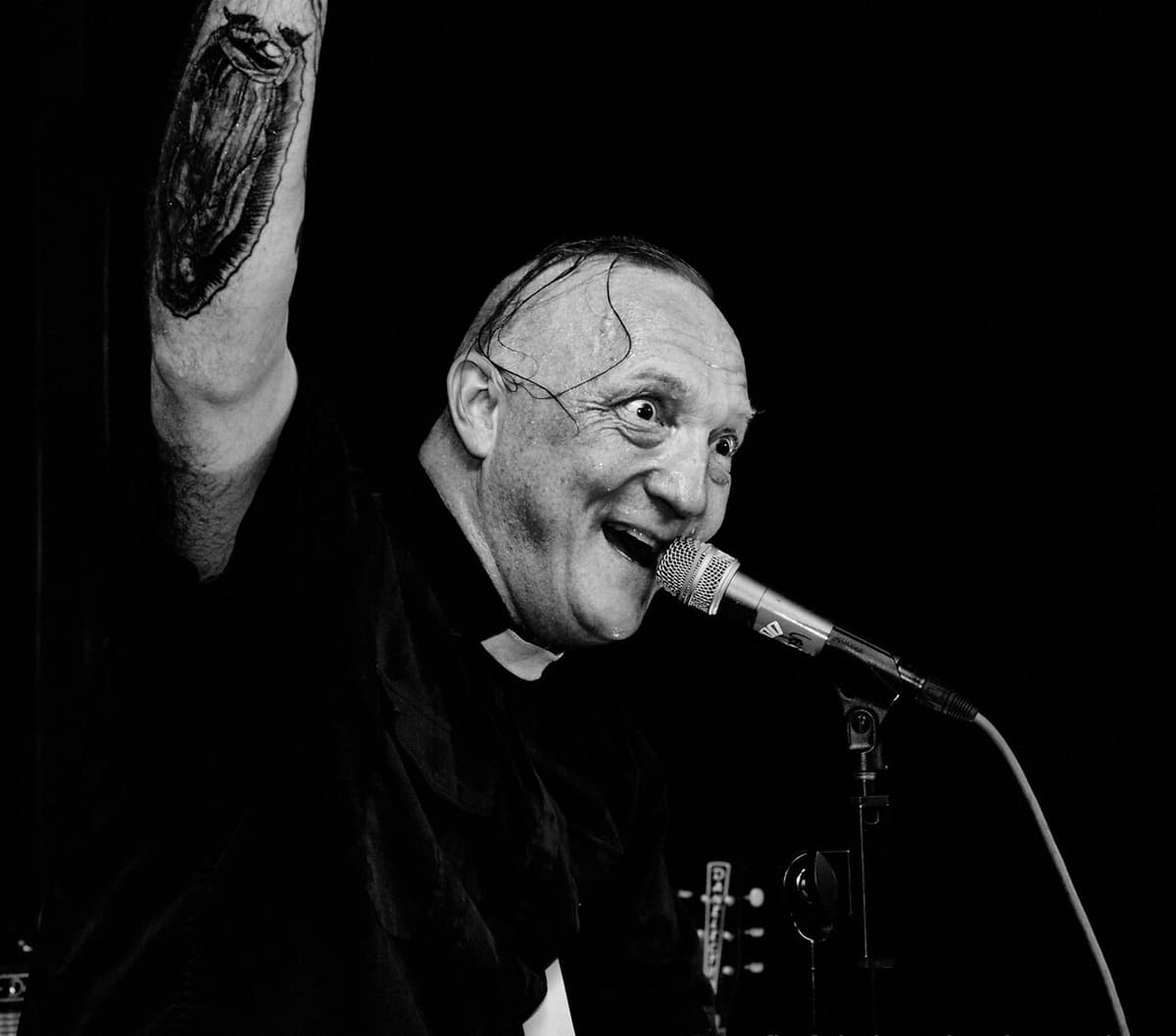
Reverend Beat-Man
Primitive, overdriven gospel-blues trash that sounds like a haunted juke joint. Raw one-man band energy for fans of wild, unpolished rock and roll.
Primitive, overdriven gospel-blues trash that sounds like a haunted juke joint. Raw one-man band energy for fans of wild, unpolished rock and roll.
Reverend Beat-Man delivers a sonic baptism in the church of 'Blues Trash.' It is music that feels like it was unearthed from a shallow grave in 1955, then plugged into a modern amplifier that is about to catch fire. The sound is defined by a relentless, primitive stomp, a guitar tone that is more grit than melody, and a vocal delivery that oscillates between a possessed preacher and a delta blues ghost.
What makes him truly distinctive is the 'one-man band' architecture. Because he is often playing the drums with his feet while wrestling a guitar, the rhythm has a frantic, slightly unhinged quality that a full band could never replicate. It is the sound of a man fighting his instruments and winning. He blends the sacred and the profane, using gospel imagery to tell stories of lust, death, and surrealist absurdity.
Start with 'Surreal Folk Blues Gospel Trash Vol. 1' to hear the blueprint of his aesthetic. It captures the raw, unpolished essence of his Voodoo Rhythm label and serves as the perfect entry point into his world of distorted Americana and Swiss psychobilly madness.
Beat Zeller (born 1967), better known as Beat-Man or Reverend Beat-Man, is a Swiss musician, DJ and record company owner. He performs as a one-man band, as the leader of psychobilly band The Monsters, and with other bands, in a style described as primitive rock and roll and as "gospel blues trash". He is also the founder and head of Voodoo Rhythm Records, a company based in Bern, Switzerland.
Shares garage rock, blues rock, rockabilly (subgenres); lo fi, noise textured, analog warmth (production style)
Shares garage rock, punk rock, blues rock (subgenres); lo fi, noise textured, analog warmth (production style)
Shares blues rock, rockabilly, punk rock (subgenres); lo fi, noise textured, analog warmth (production style)
Shares garage rock, punk rock, rockabilly (subgenres); dive bar, basement show, urban night (atmosphere)
Shares garage rock, rockabilly, blues rock (subgenres); dive bar, basement show, bonfire (atmosphere)
Shares garage rock, blues rock, rockabilly (subgenres); lo fi, analog warmth, stripped back (production style)
Shares lo fi, noise textured, analog warmth (production style); garage rock, blues rock, punk rock (subgenres)
Shares lo fi, noise textured, analog warmth (production style); dive bar, basement show, bonfire (atmosphere)
Shares garage rock, blues rock, rockabilly (subgenres); dive bar, basement show, urban night (atmosphere)
Shares garage rock, blues rock, punk rock (subgenres); lo fi, noise textured, analog warmth (production style)
Shares rockabilly, harmonica, lo fi, blues rock (subgenre)
Cassette uses generative AI to enrich its catalog. How we use AI →


