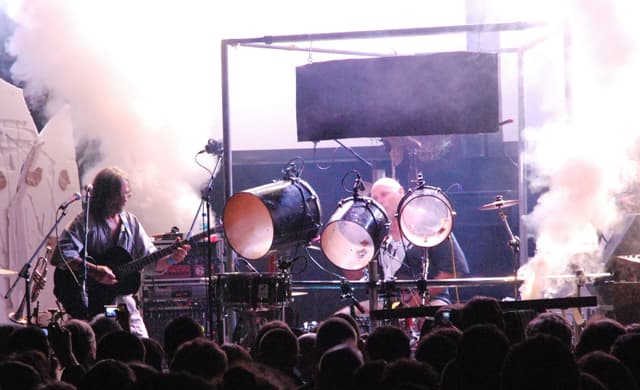
Faust
A collage of industrial clatter, hypnotic rhythms, and tape-loop madness. It is the sound of a studio being used as a demolition site and a playground at once.
A collage of industrial clatter, hypnotic rhythms, and tape-loop madness. It is the sound of a studio being used as a demolition site and a playground at once.
Listening to Faust feels like wandering through a massive, abandoned factory where the machines have started making music on their own. It is a chaotic, thrilling experience where a beautiful folk melody might be suddenly interrupted by the sound of a chainsaw or a burst of radio static. There is a sense of lawless creativity at play, where the studio itself is the primary instrument, used to slice, dice, and reassemble reality into something unrecognizable.
What sets them apart is their total lack of reverence for song structure. While their peers in the Krautrock scene often leaned into smooth, hypnotic repetition, Faust preferred the jump-cut. They pioneered the use of tape manipulation and industrial noise years before those techniques became standard in electronic and industrial music. They are the masters of the 'musical non-sequitur,' moving from pastoral bliss to mechanical aggression in a single heartbeat.
Start with Faust IV for a slightly more accessible entry point that still retains their signature weirdness. From there, dive into their self-titled debut to hear the raw, unfiltered sound of a band rewriting the rules of recorded sound in real time. It is essential listening for anyone who thinks they have heard everything rock music can do.
Faust (German: [faʊ̯st], English: "fist") are a German rock band from Hamburg. Formed in 1971 by producer and former music journalist Uwe Nettelbeck (1940 - 2007), the group was originally composed of Werner "Zappi" Diermaier (b.1949), Hans Joachim Irmler (b.1950), Arnulf Meifert (b.1943), Jean-Hervé Péron (b.1949), Rudolf Sosna (1946 – 1996) and Gunther Wüsthoff, working with engineer Kurt Graupner. Their work was oriented around dissonance, improvisation, and experimental electronic approaches, and would influence subsequent ambient and industrial music. They are considered a central act of West Germany's 1970s krautrock movement. They have been cited as an influence by Radiohead, Swell Maps, Throbbing Gristle, Cabaret Voltaire, Stereolab, Simple Minds, Sonic Youth, Mark E. Smith, Nurse with Wound and Madlib.
Shares mysterious, restless, playful (moods); sample based, tape saturation, lo fi (production style)
Shares sample based, tape saturation, lo fi (production style); psychedelic rock, art rock (subgenres)
Shares noise rock, art rock (subgenres); deadpan, spoken word, absent (vocal style)
Shares psychedelic rock, art rock, noise rock (subgenres); mysterious, restless, intense (moods)
Shares psychedelic rock, noise rock, art rock (subgenres); mysterious, restless, haunting (moods)
Shares psychedelic rock, art rock, noise rock (subgenres); tape saturation, lo fi, noise textured (production style)
Shares psychedelic rock, art rock, noise rock (subgenres); mysterious, restless, haunting (moods)
Shares psychedelic rock, art rock, noise rock (subgenres); mysterious, restless, playful (moods)
Shares mysterious, restless, playful (moods); basement show, urban night, focused work (atmosphere)
Shares psychedelic rock, art rock, noise rock (subgenres); lo fi, tape saturation, noise textured (production style)
Shares noise rock, psychedelic rock, spoken word, art rock (signature)
Shares noise rock, organ, psychedelic rock, art rock (subgenre)
Cassette uses generative AI to enrich its catalog. How we use AI →


