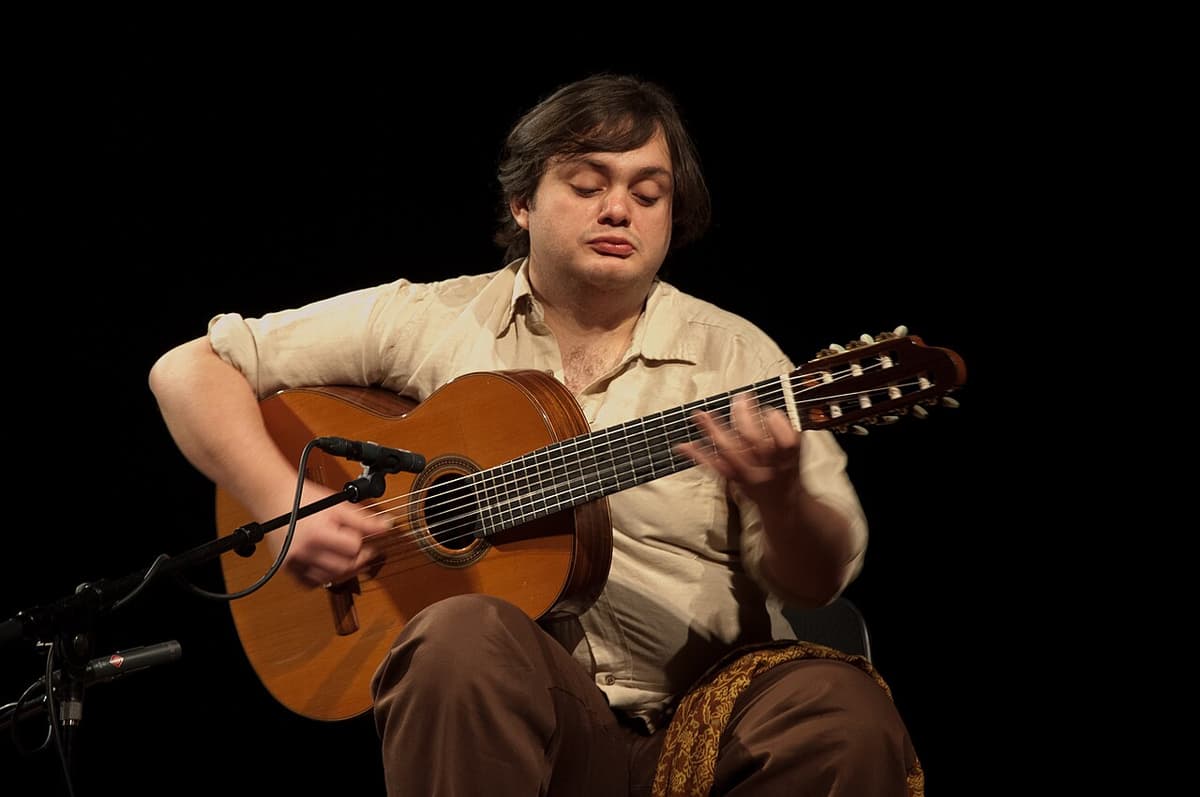
Yamandu Costa
Breathtaking seven-string guitar mastery that bridges Brazilian choro and Argentine folk. Percussive, lightning-fast, and deeply soulful acoustic performances.
Breathtaking seven-string guitar mastery that bridges Brazilian choro and Argentine folk. Percussive, lightning-fast, and deeply soulful acoustic performances.
Yamandu Costa plays the guitar with a ferocity and tenderness that feels like witnessing a physical conversation between man and wood. His seven-string classical guitar produces a massive, orchestral sound, where deep bass lines rumble beneath intricate, crystalline melodies. It is music that captures the heat of a Rio street corner and the lonely wind of the southern pampas simultaneously.
What truly sets him apart is his rhythmic vitality. He doesn't just play notes; he coaxes a whole percussion section out of the guitar body, using his thumb for driving bass patterns and his fingers for dizzying, improvisational runs. There is a sense of joyful risk in every performance, a feeling that he is pushing the instrument to its absolute structural limits.
Start with 'Continente' to hear his ability to weave together the disparate sounds of South America. It is the perfect introduction to his technical wizardry and his deep emotional resonance, making it ideal for moments of focused appreciation or a sophisticated backdrop to a quiet evening.
Yamandu Costa (born January 24, 1980, in Passo Fundo), sometimes spelled Yamandú, is a Brazilian guitarist and composer. His main instrument is the violão de sete cordas, the Brazilian seven-string classical guitar. Costa began to study guitar at age seven with his father, Algacir Costa, leader of the group Os Fronteiriços (The Frontiersmen), and mastered the instrument under the guidance of Lúcio Yanel, an Argentine virtuoso, who lived in Brazil. At age fifteen, Costa began to study southern Brazilian folk music, as well as the music of Argentina and Uruguay. Influenced by the music of Radamés Gnattali, he began to study the music of other Brazilians, such as Baden Powell de Aquino, Tom Jobim and Raphael Rabello. At age seventeen he played in São Paulo for the first time at the Cultural Circuit Bank of Brazil; the concert was produced by Study Tone Brazil. Yamandu Costa gained increased international recognition after he appeared in Mika Kaurismäki's 2005 documentary film Brasileirinho. The film showcased the vibrant world of Brazilian choro music and featured Costa’s impressive guitar skills, which helped him reach a broader audience. While he was already an established musician in Brazil, the documentary played a significant role in elevating his profile internationally. Costa's diverse styles include choro, bossa nova, milonga, tango, samba and chamamé. His 2019 album Vento Sul was considered one of the 25 best Brazilian albums of the second half of 2019 by the São Paulo Association of Art Critics. In 2021, his album Toquinho e Yamandu Costa - Bachianinha (Live at Rio Montreux Jazz Festival) (with Toquinho) won the Latin Grammy Award for Best Instrumental Album.
Cassette uses generative AI to enrich its catalog. How we use AI →


