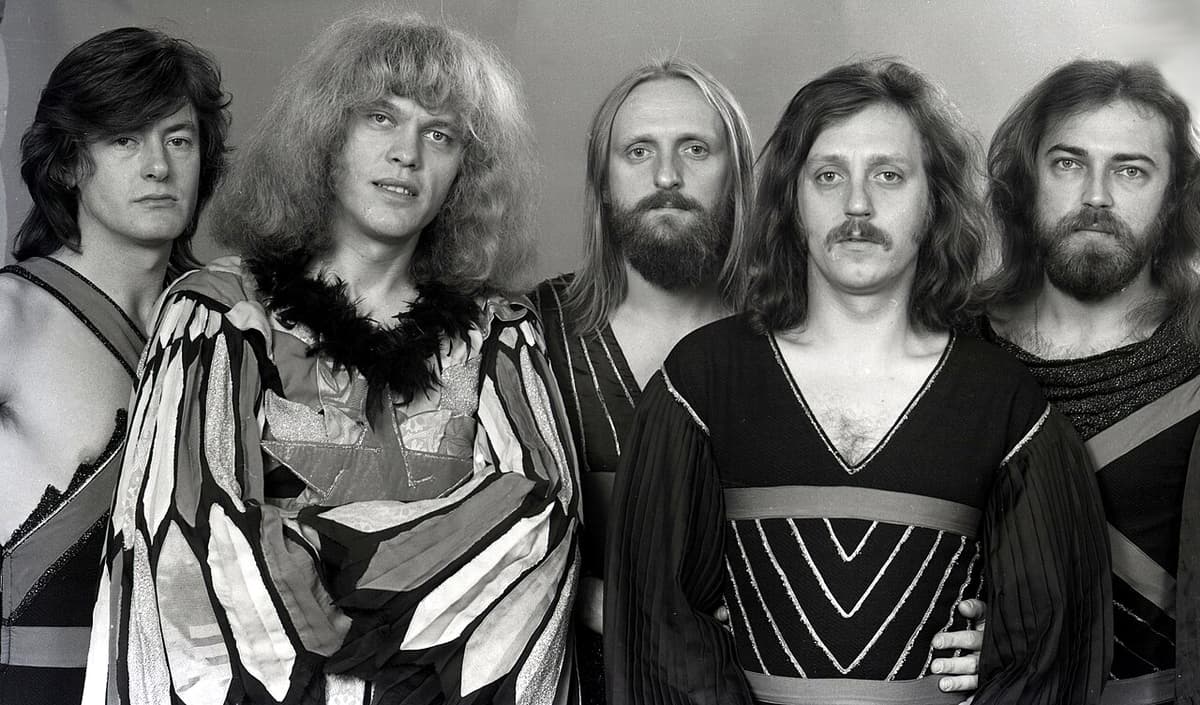
Omega
Epic Hungarian space rock that pairs cosmic synthesizer sweeps with heavy, operatic grit. A massive, star-bound sound for fans of high-stakes progressive rock.
Epic Hungarian space rock that pairs cosmic synthesizer sweeps with heavy, operatic grit. A massive, star-bound sound for fans of high-stakes progressive rock.
Omega sounds like the 1970s reaching for the stars from behind the Iron Curtain. Their music is a grand architecture of sound, built on a foundation of heavy Hammond organs, soaring electric guitars, and the unmistakable, dramatic vibrato of János Kóbor. It is rock music that feels both ancient and futuristic, blending the earthy grit of hard rock with the ethereal, shimmering textures of early synthesizers.
What makes them truly distinctive is their 'Space Rock' era, where they moved away from Beatles-esque pop toward sprawling, cosmic suites. Unlike their Western contemporaries who often leaned into clinical precision, Omega maintained a raw, emotional heat. The production is characterized by a massive sense of scale, using reverb and dense layering to create a wall of sound that feels like it could fill a stadium or a galaxy.
Start with the 1969 classic '10000 lépés' to hear their transition into psych-rock greatness, then move to 'Gammapolis' for the peak of their symphonic, space-age ambition. It is the perfect entry point for anyone who loves the heavy atmosphere of Uriah Heep but wants a more celestial, experimental edge.
Omega were a Hungarian rock band formed in 1962, which has been described as the most successful Hungarian band in history. They released more than 20 albums both in Hungarian and English, and one in German. After several early personnel changes, their classic lineup came together in 1971 and was intact for more than forty years. Singer János Kóbor was with the band continuously from 1962 until his death in 2021; keyboardist/singer László Benkő was present from 1962 until his death in 2020. Guitarist György Molnár and bassist Tamás Mihály joined in 1967, and drummer Ferenc Debreczeni joined in 1971. The band won several prestigious awards for their contributions to Hungarian culture.
Shares progressive rock, hard rock, psychedelic rock (subgenres); triumphant, mysterious, brooding (moods)
Shares progressive rock, hard rock, psychedelic rock (subgenres); analog warmth, reverb heavy, layered dense (production style)
Shares progressive rock, hard rock, psychedelic rock (subgenres); analog warmth, reverb heavy, layered dense (production style)
Shares progressive rock, hard rock, psychedelic rock (subgenres); analog warmth, reverb heavy, layered dense (production style)
Shares progressive rock, hard rock, psychedelic rock (subgenres); belting, harmonized, baritone (vocal style)
Shares progressive rock, hard rock, psychedelic rock (subgenres); triumphant, mysterious, nostalgic (moods)
Shares progressive rock, psychedelic rock, art rock (subgenres); analog warmth, reverb heavy, layered dense (production style)
Shares progressive rock, hard rock, art rock (subgenres); belting, harmonized, baritone (vocal style)
Shares progressive rock, hard rock, psychedelic rock (subgenres); analog warmth, reverb heavy, layered dense (production style)
Shares progressive rock, hard rock, psychedelic rock (subgenres); analog warmth, reverb heavy, layered dense (production style)
Shares keys/synth, wall of sound, organ, progressive rock (signature)
Cassette uses generative AI to enrich its catalog. How we use AI →


