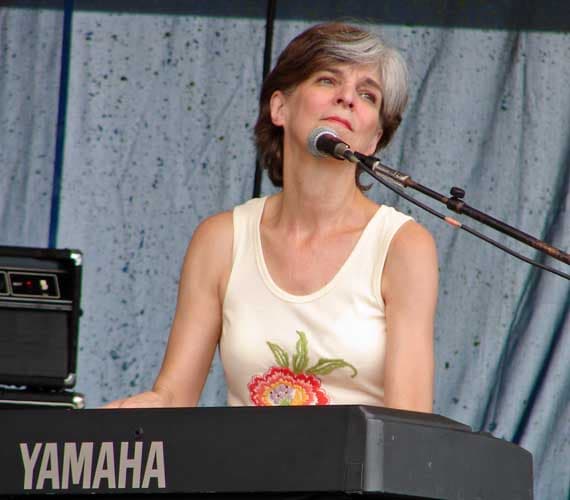
Marcia Ball
Rollicking Gulf Coast piano meets soulful Texas grit. A celebratory blend of New Orleans stomp and swampy R&B perfect for a backyard party or a long drive south.
Rollicking Gulf Coast piano meets soulful Texas grit. A celebratory blend of New Orleans stomp and swampy R&B perfect for a backyard party or a long drive south.
Marcia Ball's music is the sonic equivalent of a humid, neon-lit night on the Gulf Coast. It is anchored by her formidable 'two-fisted' piano playing, which carries the DNA of New Orleans legends like Professor Longhair and Fats Domino. The sound is thick with the groove of swamp-pop, the drive of Texas blues, and the infectious syncopation of boogie-woogie. It feels lived-in, warm, and inherently communal, like a house party where the screen door is always swinging open.
What truly sets her apart is the way she bridges the gap between the sophisticated polyrhythms of Louisiana and the straightforward, foot-stomping energy of Austin's roadhouse scene. Her voice is soulful and wise, delivering stories that feel like they were overheard at a local diner or a late-night bar. It is music that refuses to be static; even her ballads have a rhythmic pulse that suggests a slow dance on a wooden floor.
For the uninitiated, starting with her mid-80s work captures her at a high-energy peak, but her live recordings are where the true magic happens. This is music for when you want to feel the weight of the world lift through rhythm, or when you need a soundtrack that feels as authentic as a well-worn pair of boots.
Marcia Ball (born March 20, 1949) is an American retired blues singer and pianist raised in Vinton, Louisiana. Ball was described in USA Today as "a sensation, saucy singer and superb pianist... where Texas stomp-rock and Louisiana blues-swamp meet." The Boston Globe described her music as "an irresistible celebratory blend of rollicking, two-fisted New Orleans piano, Louisiana swamp rock and smoldering Texas blues from a contemporary storyteller." In October 2025, Ball announced she was diagnosed with amyotrophic lateral sclerosis, and that she would be retiring from touring and performing. In 2026 Ball was inducted into the Blues Hall of Fame.
Cassette uses generative AI to enrich its catalog. How we use AI →


