John Cale
Orchestral elegance meeting avant-garde friction. A master of tension who moves between lush chamber pop and jagged, menacing rock with a scholar's precision.
Orchestral elegance meeting avant-garde friction. A master of tension who moves between lush chamber pop and jagged, menacing rock with a scholar's precision.
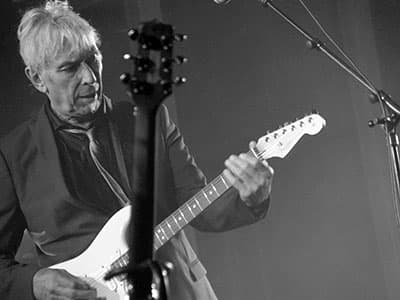
John Cale is a foundational figure in the bridge between 20th-century avant-garde composition and modern rock. A classically trained violist from Wales, Cale’s trajectory changed when he moved to New York and joined La Monte Young's Theatre of Eternal Music, where he mastered the art of the drone.
This sensibility became the sonic backbone of The Velvet Underground, where Cale’s use of distorted viola and percussive bass provided the experimental friction to Lou Reed’s street-level songwriting. After his 1968 departure, Cale embarked on a solo career defined by radical stylistic shifts, ranging from the lush, literary chamber pop of 'Paris 1919' to the jagged proto-punk of his Island Records trilogy. As a producer, he was instrumental in shaping the sound of the 1970s, helming debut albums for The Stooges, Patti Smith, and The Modern Lovers. His work is characterized by a high-low synthesis: the intellectual rigor of the conservatory applied to the visceral energy of rock and roll. Critical consensus views him as the 'architect of noise' whose influence on post-punk, gothic rock, and indie-classical is immeasurable.
Shares art rock, chamber pop (subgenres); brooding, melancholic, restless (moods)
Shares mysterious, melancholic, intense (moods); art rock, chamber pop (subgenres)

Shares art rock, chamber pop (subgenres); orchestral_arrangement, studio_polished, analog_warmth (production style)
Shares mysterious, melancholic, intense (moods); art rock, chamber pop (subgenres)
Shares mysterious, intense, brooding (moods); art rock, chamber pop (subgenres)
Shares brooding, mysterious, melancholic (moods); urban_night, late_night, rainy_day (atmosphere)
Shares art rock, spoken_word, chamber pop, deadpan (signature)
Cassette uses generative AI to enrich its catalog. How we use AI →