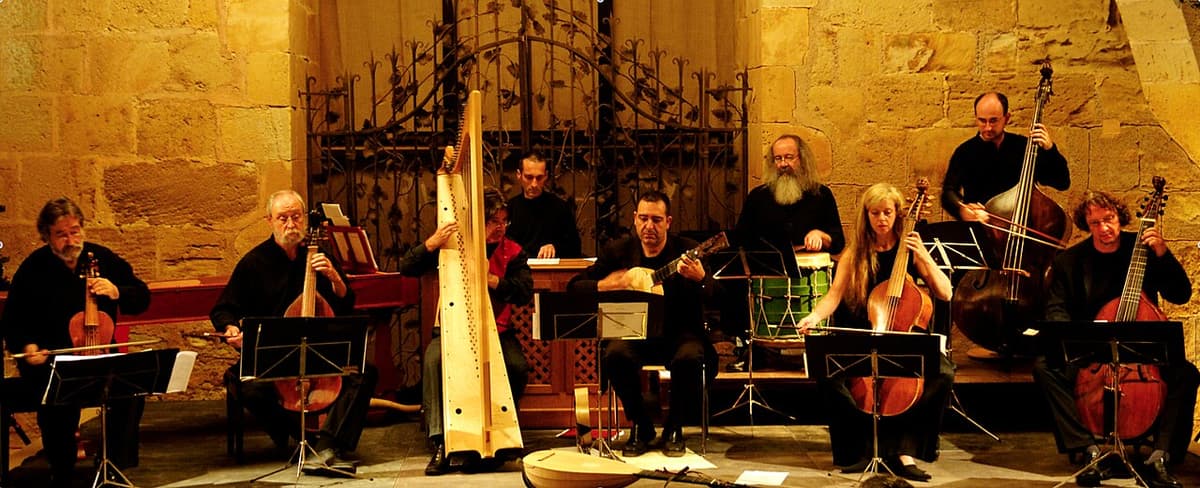
Hespèrion XXI
Haunting period instruments and ethereal vocals that bridge the gap between ancient history and living emotion. Intimate, scholarly, and deeply spiritual.
Haunting period instruments and ethereal vocals that bridge the gap between ancient history and living emotion. Intimate, scholarly, and deeply spiritual.
Listening to Hespèrion XXI is like stepping through a hidden door into a forgotten century. The sound is anchored by the woody, resonant ache of Jordi Savall's viola da gamba, which feels less like a museum piece and more like a living, breathing voice. It is music that feels ancient but never dusty, possessing a vibrant, rhythmic pulse that suggests these melodies were once the pop songs and dance hits of their era.
What truly sets them apart is their commitment to improvisation. While many early music ensembles treat scores as rigid blueprints, Savall and his collaborators treat them as conversations. You can hear the spontaneous interplay between the percussion, the breathy flutes, and the shimmering strings, creating a sense of immediacy that makes 500 year old music feel like it was composed this morning in a moment of sudden inspiration.
Start with 'Diáspora sefardí' to hear how they weave together Jewish, Christian, and Muslim musical traditions. It is a masterclass in cultural dialogue, showcasing the ensemble's ability to find the universal human emotion buried within specific historical contexts. It is the perfect companion for deep focus, late-night reflection, or any moment where you want to feel the long thread of history.
Hespèrion XXI is an international early music ensemble. The group was formed in Basel, Switzerland in 1974 as Hespèrion XX by Catalan musical director Jordi Savall (bowed string instruments, particularly the viola da gamba), his wife Montserrat Figueras (soprano), Lorenzo Alpert (flute, percussion), and Hopkinson Smith (plucked string instruments). The group changed its name to Hespèrion XXI at the beginning of the 21st century. The name "Hespèrion" is derived from a word in Classical Greek which referred to the people of the Italian and Iberian peninsulas. The ensemble is noted for its scholarship in early music, especially the music of 16th and 17th century of Spain. Their performance practice is noted for the liberal use of improvisation around the basic melodic and rhythmic structures of the early pieces, resulting in great emotional intimacy and immediacy.
Cassette uses generative AI to enrich its catalog. How we use AI →


