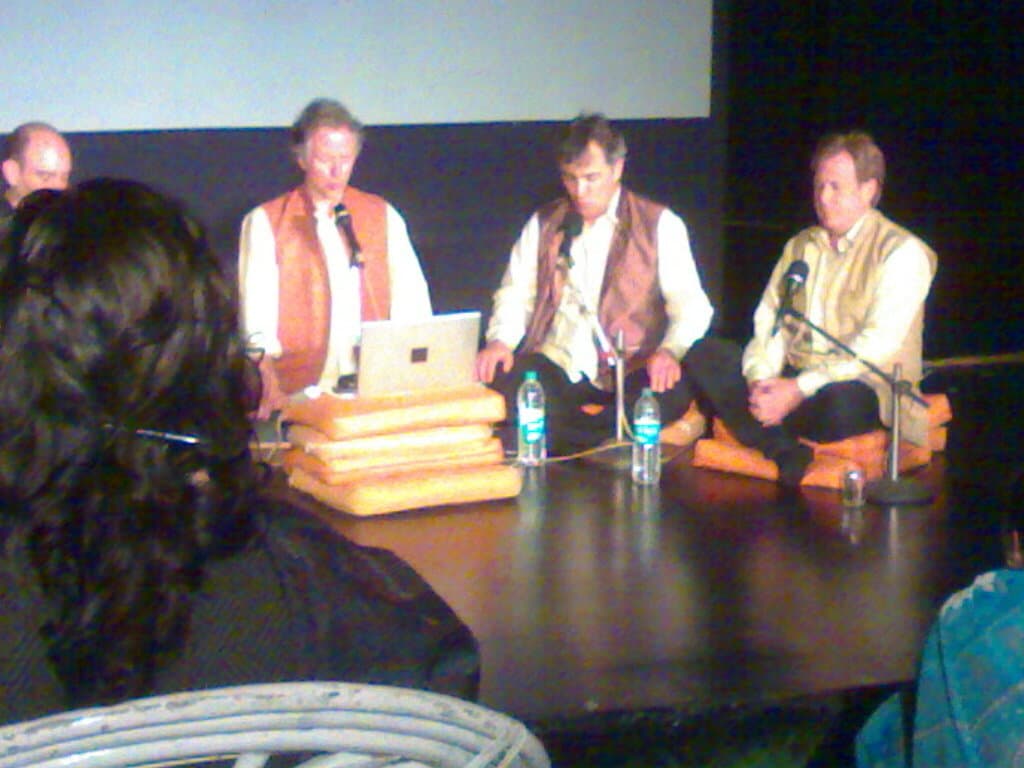
David Hykes
Ethereal vocal overtones that sound like glass bells ringing inside a limestone cavern. Pure, meditative polyphony for deep focus and spiritual stillness.
Ethereal vocal overtones that sound like glass bells ringing inside a limestone cavern. Pure, meditative polyphony for deep focus and spiritual stillness.
Listening to David Hykes is like witnessing light pass through a prism, but for the ears. His music is built on the physics of sound itself, using the human voice to generate 'overtones' - high, flute-like melodies that float above a deep, resonant drone. It feels less like a performance and more like a natural phenomenon, similar to the way wind whistles through a canyon or waves vibrate in a sea cave. It is profoundly still, yet vibrating with internal life.
What makes Hykes truly distinctive is his mastery of Harmonic Chant. Unlike traditional choral music which relies on multiple singers for different notes, Hykes and his ensemble can produce multiple notes simultaneously from a single throat. This creates a shimmering, 'rainbow' effect where the harmonics seem to detach from the singers and hang in the air like independent entities. It is a sound that bypasses the intellect and speaks directly to the nervous system, inducing a state of calm alertness.
For those new to this sonic world, 'Hearing Solar Winds' is the essential starting point. Recorded in a French abbey, it captures the perfect marriage of vocal technique and architectural resonance. It is best experienced in a quiet environment with high-quality headphones, allowing the subtle, whistling frequencies to fully reveal themselves against the deep, grounding bass of the choir.
David Hykes (born March 2, 1953) is an American composer, singer, musician, author, and meditation teacher. He was one of the earliest modern western pioneers of overtone singing, and since 1975 has developed a comprehensive approach to contemplative music which he calls Harmonic Chant (harmonic singing). After early research and trips studying Mongolian, Tibetan, and Middle Eastern singing forms, Hykes began a long series of collaborations with traditions and teachers of wisdom and sacred art, including the Dalai Lama and monks of the Gyume and Gyuto Orders. Hykes founded the Harmonic Choir in 1975, and has performed and taught Harmonic Chant and the related Harmonic Presence work in America, France, Germany, Italy, Switzerland, Japan, Australia and many other countries. Of overtone singing and his own study of the form, music theorist Charles Madden writes, "David Hykes has done everything I had hoped to do, and more." His choir incorporates both basic overtone singing as well as additional advanced forms. His work is organised within The Harmonic Presence Foundation. His song, "Rainbow Voice", has been featured in the films Blade: Trinity (2004), Blade (1998), Baraka (1992), and Dead Poets Society (1989).
Cassette uses generative AI to enrich its catalog. How we use AI →


