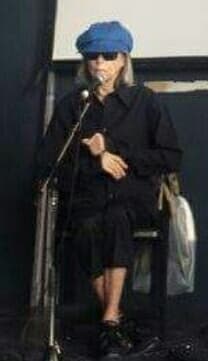
Annette Peacock
Haunting, sparse compositions where human breath meets early synthesizer grit. A pioneer of intimate, avant-garde soul for late-night reflection.
Haunting, sparse compositions where human breath meets early synthesizer grit. A pioneer of intimate, avant-garde soul for late-night reflection.
Annette Peacock sounds like the exact moment a human voice dissolves into an electrical current. Her music is defined by an incredible sense of space, where the silence between notes is just as heavy as the notes themselves. It is a world of low-slung bass lines, skeletal piano chords, and a vocal delivery that sits somewhere between a secret whispered in your ear and a transmission from a distant satellite. There is a profound, unhurried sensuality to her work that feels both ancient and futuristic.
What makes her truly distinctive is her pioneering use of the Moog synthesizer, not as a lead instrument, but as a processor for her own voice. She was one of the first to treat the vocal cord as a raw oscillator, bending her pitch and timbre through analog circuits to create a sound that is eerily post-human yet deeply emotional. Her phrasing is idiosyncratic, often ignoring standard rhythmic grids in favor of a conversational, free-form flow that demands the listener's full presence.
To begin, listen to 'I'm The One' for her most radical electronic experiments, or 'An Acrobat's Heart' if you prefer a more stripped-back, chamber-jazz approach. The former is a landmark of avant-garde funk and synthesis, while the latter showcases her mastery of the piano and string quartet. Both reveal an artist who has spent her entire life operating on the absolute fringes of pop and jazz, creating a genre of one.
Annette Peacock (born 1941) is an American composer, musician, songwriter, producer, and arranger. She is a pioneer in electronic music who combined her voice with one of the first Moog synthesizers in the late 1960s.
Cassette uses generative AI to enrich its catalog. How we use AI →


